

What are Badges and Awards?
Girl Scouts at each level have their own earned awards and badges.
When a Girl Scout earns a badge, it shows that she’s learned a new skill, such as how to make a healthy snack or take great digital photos. It may even spark an interest at school or plant the seed for a future career. Please remember that we don’t expect you to be an expert in the badge topics; just have fun learning by doing with the girls!
While you’re having fun, keep in mind: badges are for educating girls, not for decorating their sashes and vests. The quality of a Girl Scout’s experience—and the skills and pride she gains from earning leadership awards and skill-building badges—far outweigh the quantity of badges she earns.
If you are working with Girl Scout Daisies, please note that they may earn Petals in addition to skill building badges.
Find Badge and Award Information
The Badge Explorer provides an overview of the steps needed to earn each official badge at every Girl Scout level. Badge pamphlets provide more detailed information and can be purchased in the retail shops or the online store, and are also available for free digital download through the Volunteer Toolkit. Volunteers should access the Volunteer Toolkit to find complete meeting plans, including detailed activity instructions and additional resources.
Where to purchase emblems, insignia, and awards
You can purchase emblems and patches, along with badges and leadership awards online, by emailing shop@gsnorcal.org, or in person at one of our shops.
Where to place emblems, insignia, and awards
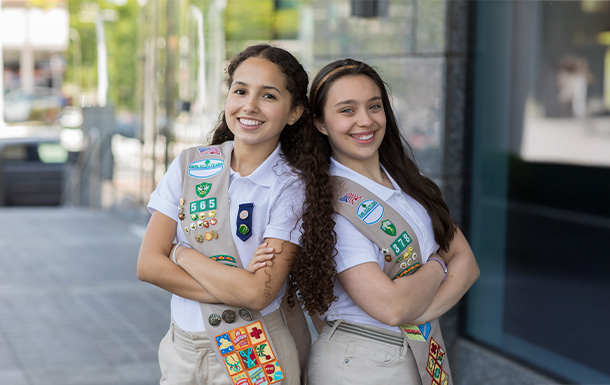
The Uniform Insignia Booklet shows the emblems and earned awards for each grade level with illustrations which show exactly where girls can place their emblems, awards, badges, pins, and patches on their vests and sashes.
Participation patches (or fun patches) represent activities girls have tried and are fun ways for girls to remember special events they’ve attended. Since these patches and pins aren’t tied to skill-building activities like the earned awards are, they are worn on the back of a girl’s sash or vest. Think of the back of the vest or sash as a scrapbook for the year.
National Awards and Programs
From the beginning of Girl Scouts, several prestigious awards have recognized the girls who make a difference in their communities and in their own lives. The first of these awards, in 1916, was the Golden Eagle of Merit. In 1919, the name changed to The Golden Eaglet, and in 1920, the requirements for The Golden Eaglet were updated. The First Class Award existed for only two years, from 1938–1940, and was replaced in 1940 with The Curved Bar Award, the requirements for which were updated in 1947. In 1963, GSUSA re-introduced the First Class Award, for a girl who was an “all-around” person, with skills in many fields and a proficiency in one. Today’s highest award, the Girl Scout Gold Award, was introduced in 1980. Learn more about the Girl Scout Bronze, Silver, and Gold Awards.
The Girl Scout Law includes many of the principles and values common to most faiths. And even though Girl Scouts is a secular organization, we’ve always encouraged girls to explore spirituality via their own faiths. Girls of all grade levels can do this by earning the My Promise, My Faith pin. By carefully examining the Girl Scout Law and directly tying it to tenets of her faith, a girl can earn the pin once each year she participates in Girl Scouting. The My Promise, My Faith pin can be earned by girls of any faith. (My Promise, My Faith FAQ)
Religious recognition programs are also developed and administered by each of the major religious groups themselves. Through Girl Scouting, each girl is encouraged to become a stronger member of her own religion. Girls who choose to participate in one of these programs usually do so outside of their regular troop meetings with a group of girls guided by a spiritual counselor or with their own families. Individual awards are listed on GSNorCal’s website. PRAY (Programs of Religious Activities with Youth) works with various religious groups to develop requirements for the various awards. You can find information about requirements and ordering information on the PRAY website.
The Take Action award and Global Action award are available to Junior, Cadette, Senior, and Ambassador Girl Scouts who want to turn their passion into action! Pick your favorite badge and use it as inspiration to create meaningful impact in your community. Many issues affect your world, both close to home and far away—focus on one that matters most to you.
The National Park Service and Girl Scouts of the United States of America have partnered to create the Girl Scout Ranger Program. Girl Scouts are invited to participate in a variety of existing, organized educational or service projects at national park sites, or design their own experience or project to align with Journey work, badge activities, or a Take Action or Highest Award project. Girl Scouts are awarded certificates and/or patches for their participation.
The Silver Torch award for Cadettes and the Gold Torch award for Senior and Ambassador Girl Scouts help you grow as a team leader. You’ll start by learning how to be a great teammate and build up to leading a group of peers within Girl Scouting or the wider community.
Juniors and Cadettes earn their Junior Aide or Program Aide award by working directly with younger girls. Check out the Junior Aide Volunteer’s Guide, Program Aide Volunteer’s Guide, Program Aide Girl Workbook and the Cadette Program Aide Facilitator’s Guide for tons of helpful information and ideas. These programs enable girls to become proficient in an area of interest, and to develop leadership skills by sharing their specialized knowledge with younger girls in a troop, group, activity, or event setting. Girls can also specialize in areas such as crafts, computers, games, and songs. For more information on Program Aide trainings, check with your local Service Unit team.
Girl Scout Seniors and Ambassadors earn these awards by completing a leadership course on youth development and girl programming in the outdoors. They then spend time practicing and honing their skills by mentoring young girls in a camp in preparation to become a camp counselor. Requirements for the CIT can be found in the Senior and Ambassador Girl’s Guide to Girl Scouting.
Additionally, Girl Scout Ambassadors can earn their CIT II Award. Girl Scout Ambassadors earn this award by working with younger girls over the course of at least one camp session while focused on increasing their skills in one specific area–such as riding instruction, ropes course instruction, lifeguarding, or the arts. Requirements can be found in the Ambassador Girl’s Guide to Girl Scouting.
Visit our camps page to learn more about GSNorCal camps and our CIT programs.
This award is for Girl Scout Seniors and Ambassadors who’d like to mentor a Girl Scout Daisy, Brownie, Junior or Cadette group outside of the camp experience. Girls who have completed ninth grade are eligible to earn this award. Girls complete a group leadership course and commit to helping a younger girl troop under the guidance of that troop’s leader. The program usually spans five to eight months with time split between course work and 25 volunteer hours with the troop.
Girls in grades 6-12 work with adult advisors to plan activities for other girls. Girls are in the driver’s seat and make decisions about issues they care about that benefit girls in their areas. This is a great way for girls to make a big impact on the council and have fun, too. For more information, email info@gsnorcal.org
GSNorCal Service Unit Delegate
Girls aged 14 and older are eligible to be a service unit delegate and attend GSNorCal’s Annual Meeting which is held each year in the spring. Service unit delegates are elected by their service units. Girl Scouts aged 14 and older are eligible to run for a one-year term. Service unit Delegates are the liaison between the members of their service unit and GSNorCal’s Board of Directors. They carry information to the members and gather input to inform their vote on issues of great importance to the future of our council.
Delegate to the National Council of GSUSA
Girls aged 14 and older are eligible to be a delegate to the National Council, which meets every three years. Delegates, who are elected by their council, serve for three years; they voice their opinions and vote on issues critical to the future of Girl Scouting.
Youth Participant on GSNorCal’s Board of Directors
Girl Scouts 14 years or older are eligible to be a Youth Board Participant. The Board of Directors meets throughout the year to conduct business. Youth board participants are elected by the council, serve for one year, voice their opinions, and vote on issues critical to the future of GSNorCal.
The troop crest is chosen by a Girl Scout troop. The crests are worn by Girl Scout Brownies, Juniors, Cadettes, Seniors, and Ambassadors. Center the troop crest directly under the council identification strip. Throughout its history, Girl Scouts has assigned no specific meaning to troop crests. The items used in troop crests, such as flowers and other natural elements, often have various meanings that have come to be associated with them by cultures around the world. Some of these elements carry multiple meanings, and sometimes their symbolism has changed and evolved through the ages. Some of these meanings are offered in the description of each crest, which may be of interest to girls and their adult volunteers.
Last updated on May 13, 2026